
Neyers Vineyards Bruce's Journal

Dining On a Warm Evening
By Bruce Neyers
Saturday 27th June, 2026
Summer Dining – What to drink when it warms up
You may have heard about the heat wave we recently experienced here in northern California, and hot weather like this alters the way we eat and drink at home. Earlier this week, for example, Barbara assembled one of my favorite warm-weather meals – Prosciutto and melon — and we enjoyed it with a slightly chilled bottle of Neyers Pinot Noir ‘Placida Vineyard.’ In the course of the meal, I mentioned to Barbara that it was difficult for me to eat melon in any form and not think of my maternal grandparents and their lives on the eastern shore of Maryland. If you’re unfamiliar with that region, it’s an extension of southeastern Pennsylvania that includes most of Delaware, a portion of Maryland — seemingly severed from the rest of the state by the Chesapeake Bay — and a tiny spot of Virginia that serves as the northern anchor of the Bridge and Tunnel Complex. The biggest town in the area is Salisbury, but my mother’s family lived in Hebron, a few miles away, in the geographic center. I once read that there was so little of merit about the area that Pennsylvania gave the land away. That was a mistake as the region includes some of the best farming land in the US. My grandparents owned some of that farming land and raised mostly soybeans. Some of it was planted to row crops, though, like corn, beans, tomatoes, strawberries, cantaloupe and – my personal favorite – watermelon. There was no Farmer’s Market in Hebron, so they sold the day’s harvest from the sidewalk in front of their porch. In summer, my parents (not surprisingly) loved it when I left home for a couple of weeks on the farm. Joined by my favorite relative, my cousin Harry, we would help my grandfather, Byrd Cooper, by ‘turning’ the melons, picking tomatoes and strawberries, and riding on the tractor with him when he took the day’s harvest home for my grandmother Bernice to display. A few years ago, Harry sent me an envelope full of old farm documents that included the bill of sale of a mule to my grandfather. He always cautioned us to stay away from that mule when they cultivated. ‘It’ll kick you,’ he warned. At the end of the day, my grandfather would discreetly press a dime in our hands. We’d walk a few blocks to the local pharmacy, sit on stools at the counter, and enjoy an icy chocolate soda. Then we’d go home to supper – almost always fried chicken or chicken and dumplings. There normally wasn’t much left from the day’s harvest by the time we returned, but my grandmother invariably kept a ripe watermelon in the ice-filled galvanized tub for us. Harry and I would sit on the sidewalk eating it and see who could spit the seeds the farthest. The next morning we’d have cold, vine-ripened cantaloupe for breakfast.
I now eat cantaloupe in the evening and enjoy the watermelon in the morning. Barbara buys both at our local market. When the cantaloupe is just right though, she’ll create what is for me a favorite meal – ripe melon garnished with the Prosciutto that she gets from the same grocer. She orders it sliced extra-thin, and I like it best with a bottle of slightly chilled Pinot Noir. It’s the Placida Vineyard Pinot that makes its way to our table for this meal. The Placida Vineyard, owned and farmed by Chuy Ordaz, is at the south-eastern end of the Russian River, not far from the original Joe Swan Pinot Noir Vineyard in Forestville. Joe always maintained that his Pinot Noir was so successful because the vines came from ‘Selection Massale’ plant material, buds that had come directly from vines in Vosne-Romanée. This was budwood of impeccable breed, planted in the complex Gold Ridge Clay soils of the Russian River, then allowed to slowly ripen in one of the coldest regions growing Pinot Noir in all of northern California. These vines should be expected to produce grapes of extraordinary character. They do especially well here, giving us wine that is dark colored, spicy, and complex with a taste of raspberry, cinnamon, nutmeg, and allspice. It’s loaded with old-world character – bright, yet rustic, and it’s perfect on a warm summer evening with Prosciutto and Melon.
Prosciutto and Melon
Ingredients
- 1 ripe cantaloupe
- 24 extra thin slices of Prosciutto San Daniele or Prosciutto di Parma
- Extra virgin olive oil – We prefer the Corsican olive oil from Marquiliani imported by Kermit Lynch
- 2 limes cut into wedges
- Fresh ground black pepper
Preparation
- Slice the cantaloupe in half and each half into quarters. Remove the outside rind.
- Place the sections of cantaloupe on a platter and arrange the sliced prosciutto on each section of melon.
- Lightly drizzle olive oil on the prosciutto, then top it with fresh ground black pepper.
- Place the lime wedges on the platter to squeeze on the prosciutto and melon just before serving.
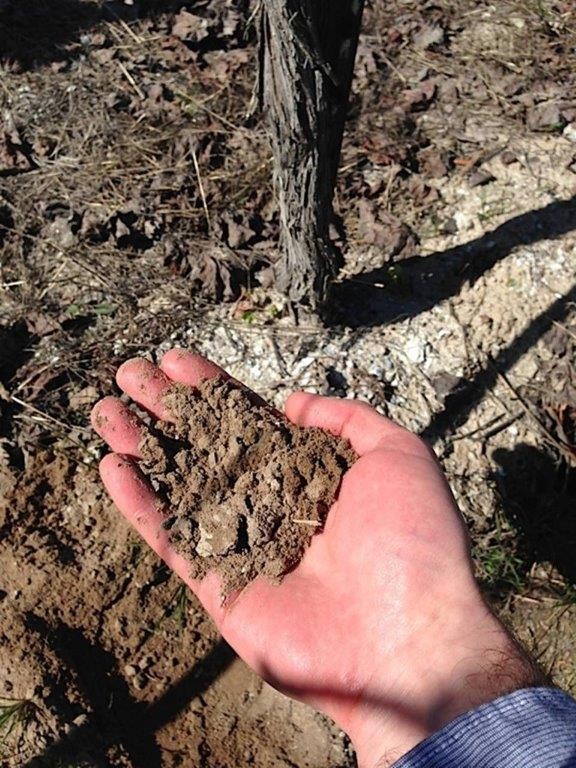
The Gold Ridge Clay soil in the Russian River Valley is actually a mix of clay, sand and loam. The Chuy Ordaz Placida Vineyard is a textbook example of this shallow, well-drained soil which is ideal for Pinot Noir, especially when found in the cold weather areas surrounding the Russian River Valley.

Neyers Vineyard Placida Vineyard Pinot Noir

This is delicious and simple to arrange, I’m told, and a perfect match with Placida Vineyard Pinot Noir.

The cool spring weather we enjoyed in May allowed for an extra large crop of butterflies of all types on our property, and we’ve enjoyed their companionship as they flit from flower to flower and plant to plant. These beautiful swallowtail butterflies seem tame enough to simply pick up so they can rest on your hand. What magnificent creatures.
Photograph by Barbara Neyers
Identification by Lizzie Neyers Mix